














01/01/2025
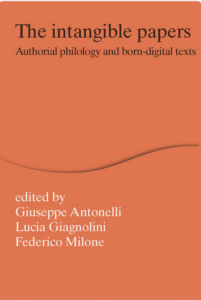
With the advent of digital technology, authorial philology faces new challenges. The “intangible papers”, made of bytes rather than paper, are the result of a radical shift in the way literature is written and experienced. And they compel archivists and philologists to rethink their methods and practices. The proceedings of the international conference The Intangible Papers. Authorial Philology and Born-Digital Texts (Pavia, 11-13 December 2023) seek to illustrate this ongoing transformation. Experts and scholars from universities and research centres share their insights and experiences on the acquisition, preservation, and enhancement of born-digital materials. With the awareness that only collaboration between archival science, computer science, and philology can ensure the longevity and accessibility of a cultural legacy essential to the future of our collective memory.
Questo libro è stato pubblicato con il contributo del Centro per gli Studi sulla Tradizione Manoscritta di Autori Moderni e Contemporanei dell’Università di Pavia.
Giuseppe Antonelli
DOI | 10.1401/9788815414328/c6
Aurèle Crasson, Laurent Alonso, Jean-Louis Lebrave and Jeremy Pedrazzi
Derrida Hexadécimal: The Forensic Genesis of “Le Toucher, Jean-Luc Nancy”
This article begins by discussing a few general statements about the traces found by geneticists who explore authors’ manuscripts in order to elucidate the creative process. The methods developed by genetic criticism for handwritten documents can be used as a starting point to study traces of a new type, namely those that can be extracted from born digital documents. The research is made even more difficult since in some cases, the nature of these traces is unknown, so as their possible localisation. Here, we present the results of a research which started in 2018 on Jacques Derrida’s digital archives. The main objective was to create codicological tools adapted to the study born of scriptural digital creation. More precisely, the Derrida Hexadécimal Project was threefold. First, to divert forensic methods and apply them to the corpus of an author who had theorised the concept of archive long before he turned to digital technology as a writing tool and archival device. Second, to…
Pagine | 123 – 147
—–
—–
Editore: Il Mulino
Pubblicazione online: 2025
Isbn edizione digitale: 9788815414328
DOI: 10.978.8815/414328
Licenza: CC BY-NC-ND
Pubblicazione a stampa: 2025
Isbn edizione a stampa: 9788815391704
Collana: Percorsi
Pagine: 248